| Vocademy |
Astronomy for Amateurs
Chapter 11
Newton
After millennia of speculation about crystalline spheres and complex machinery, Kepler finally described the elegant geometry of the heavens. It was no longer an engineer’s nightmare of eccentric circles, epicycles, and equants, but a simple motion governed by natural laws. He identified the shapes of planetary paths and a rule that described their changing speeds, yet he could not answer the deeper question—why?
Kepler proposed that the Sun exerted a magnet‑like force that both pulled and pushed the planets through their orbits. Stronger when a planet was near the Sun and weaker when it was far away, this force explained why planets accelerate at perihelion and slow at aphelion. He had nailed down the ellipses and the velocities that traced them. He had explained how the planets moved, but only touched on the underlying physics that might explain why they move at all.
Enter Isaac Newton
Isaac Newton was born on Christmas Day in 1642—by the Julian Calendar, that is. England had not yet adopted the Gregorian calendar, so when Great Britain finally swallowed its pride and accepted that “heretical Catholic document” in 1750, Newton’s birthday shifted to January 4th, 1643.[1]
Newton was born into a rural farming family. His father died before he was born, and when his mother remarried, Isaac was left in the care of his grandparents. He was expected to become a farmer, but he showed no interest in agricultural work and even less aptitude for it.
From farm boy to scholar
Newton preferred books to people and spent hours constructing mechanical models. He filled notebooks with diagrams, calculations, and self‑assigned study regimens. He was socially awkward, fiercely private, and happiest when left alone to think. He was the kid who would rather build a water clock or test prisms than play outside. Today we would call him a nerd.
Newton’s mother pulled young Isaac out of school and tried to make a proper farmer out of him. However, he showed no talent and even less interest in farming. A local teacher recognized Isaac’s true talent and urged the family to return him to his studies. He excelled in school and earned a place in Trinity College, Cambridge, where he established himself as a fiercely self-directed thinker.
Newton’s apple
When the Great Plague of 1665 forced Cambridge to close, Newton returned to his family home, Woolsthorpe Manor, and suddenly found himself in the exact environment he had always thrived in: complete isolation, no social obligations, and endless time to think.
Newton said that in the Summer-Autumn of 1666 he saw an apple fall from a tree. This singular event got Isaac to thinking. The concept that objects are attracted toward the center of the Earth was not new, but Newton wondered about the nature of this force: why was it exactly straight down; why always down and never upward; could this force extend to the Moon to keep the Moon in its orbit?
Newton’s apple story carries all the hallmarks of a historical myth. Had he not recounted it himself, it could easily be dismissed as one. If not true, it at least reflects the line of thought that led him toward universal gravitation.
Inventing calculus
Newton wanted to understand how to quantify acceleration and the movement of falling objects, curved trajectories, and the planetary motion described by Kepler. At his time, no mathematician had developed a general mathematical language for anything other than steady states and uniform motion. Newton needed a way to describe acceleration itself—the instantaneous velocity of an object whose speed is constantly changing—as well as tangent lines and areas under curves.
Classical algebra can easily solve simple problems like uniform acceleration, such as the velocity and distance traveled by an object accelerated at one meter per second squared from a standstill. But Newton needed a method to calculate the velocity of an object whose acceleration changes from moment to moment, for example, a planet speeding up as it approaches the Sun under stronger gravitational influence.
Newton set aside his early thoughts on gravity while he turned to a series of mathematical problems. He became deeply interested in infinite series, algebraic curves, and geometric methods, drawing inspiration from John Wallis’s Arithmetica Infinitorum and Descartes’s La Géométrie. In 1665 Newton found a way to take expressions that seemed impossible to work with and break them into infinitely many tiny, manageable parts. That insight became one of the stepping‑stones to calculus.
Once he could express algebraic quantities as series, Newton began integrating them term by term. In this way he obtained series expansions for functions such as the logarithm and the inverse sine, quantities that had previously been difficult to handle with existing algebra.
Building on Isaac Barrow’s geometric techniques, Newton used infinitesimal changes to relate the slope of a curve to the area under it. This led him to formulate the two central operations of calculus: differentiation and integration. He described varying quantities as fluents (flowing values) and their instantaneous rates of change as fluxions. These ideas formed the core of his method of fluxions, developed during 1665–1666, well before he applied any of this mathematics to problems of motion or gravity.
Newton did not imagine a curve as a collection of tiny segments, as later mathematicians did. He treated a changing quantity, such as a point moving along a curve, as a continuously flowing value he called a fluent. Its instantaneous rate of change was the fluxion. The direction of that change was supplied by the geometry of the curve itself, through its tangent. In this sense, Newton’s method anticipated modern vector analysis, where a point’s motion is represented by a single object combining location, direction, and rate of change. Newton kept these elements separate: the fluent gave the position, the tangent supplied the direction, and the fluxion provided the instantaneous speed. For example, in calculating a planet’s orbit, the direction of motion is determined by the shape of the orbit—an ellipse. The planet’s position, flowing along the ellipse, is the fluent, and the fluxion is its instantaneous speed along the tangent.
Optics
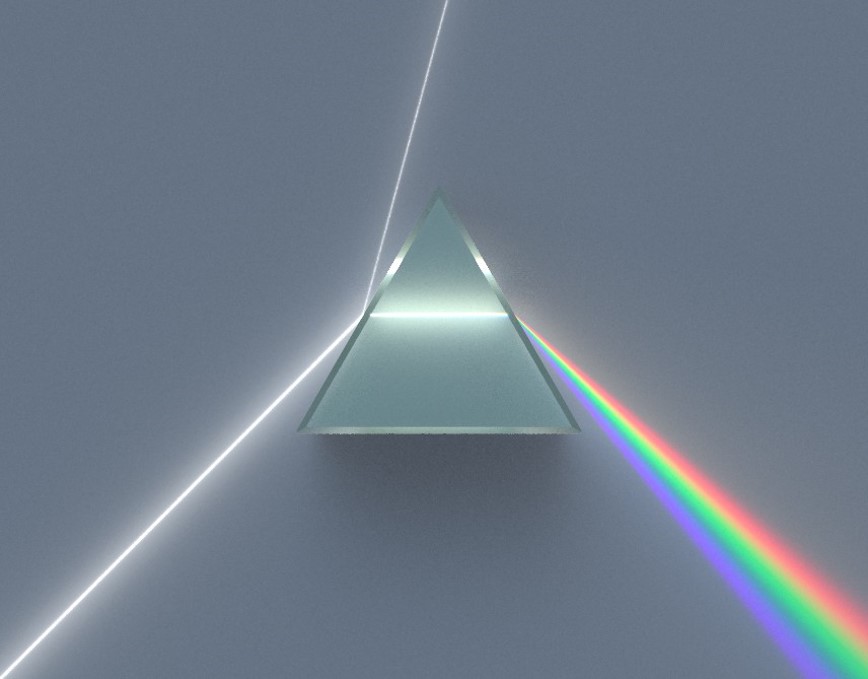
In observing white light after passing through a prism,
Newton noticed that different colors were bent by different amounts: blue being
refracted the most and red the least.
 |
|
|
He called this spreading of the colors a spectrum. He also found that a second prism, placed at the proper angle, would bend the colors back together again, restoring the original white light. He then isolated the colors individually and observed that when a single color is sent through a prism, it does not change or break into a new spectrum of colors.
After separating colors with a prism, Newton illuminated various colored objects with the individual colors from the spectrum. He discovered that when an object was lit with light close to its own color, it appeared bright and vivid. But when he illuminated the same object with a color different from its own, the object appeared dark. For example, illuminating a red apple with green light caused it to look dark and nearly black, in contrast to the bright red it showed under red light.
From his experiments with prisms, Newton concluded that a known problem with telescopes—a smearing of colors that produced colored fringes around bright objects—was caused by the main lens dispersing the colors like a prism. Makers of astronomical telescopes, such as Christiaan Huygens, built extremely long refractors (telescopes using a lens as the main element) because a long focal length requires only a very gently curved objective lens (the main lens at the front), which reduces chromatic aberration.
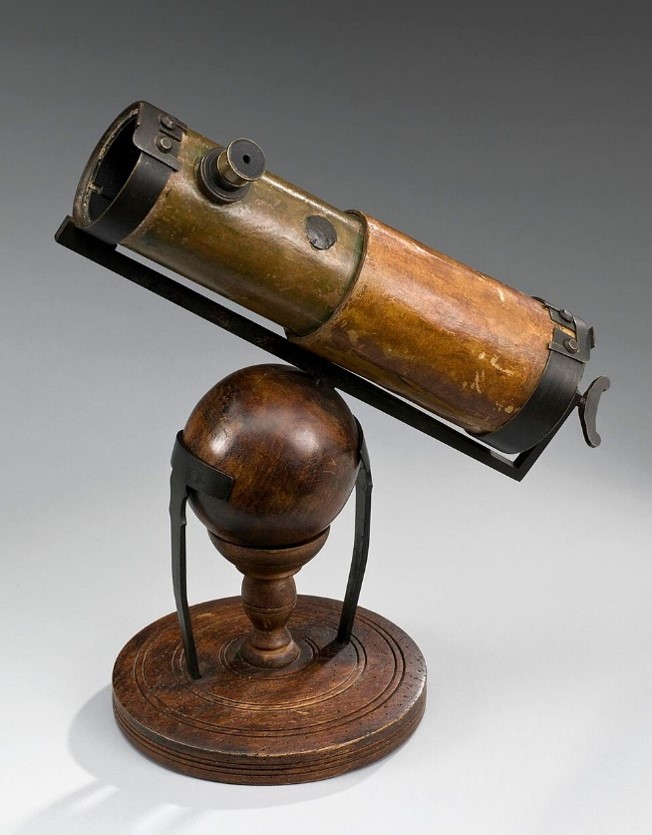
Newton decided to bypass the problem entirely by replacing the objective lens with a curved mirror. Because reflection does not separate colors, a mirror introduces no chromatic dispersion. This allowed Newton to build a telescope that was far more compact than the long refractors of his day, while still producing a sharp, chromatic aberration‑free image. The shorter design also gave a wider, brighter field of view, at the expense of lower magnification.
 |
|
|
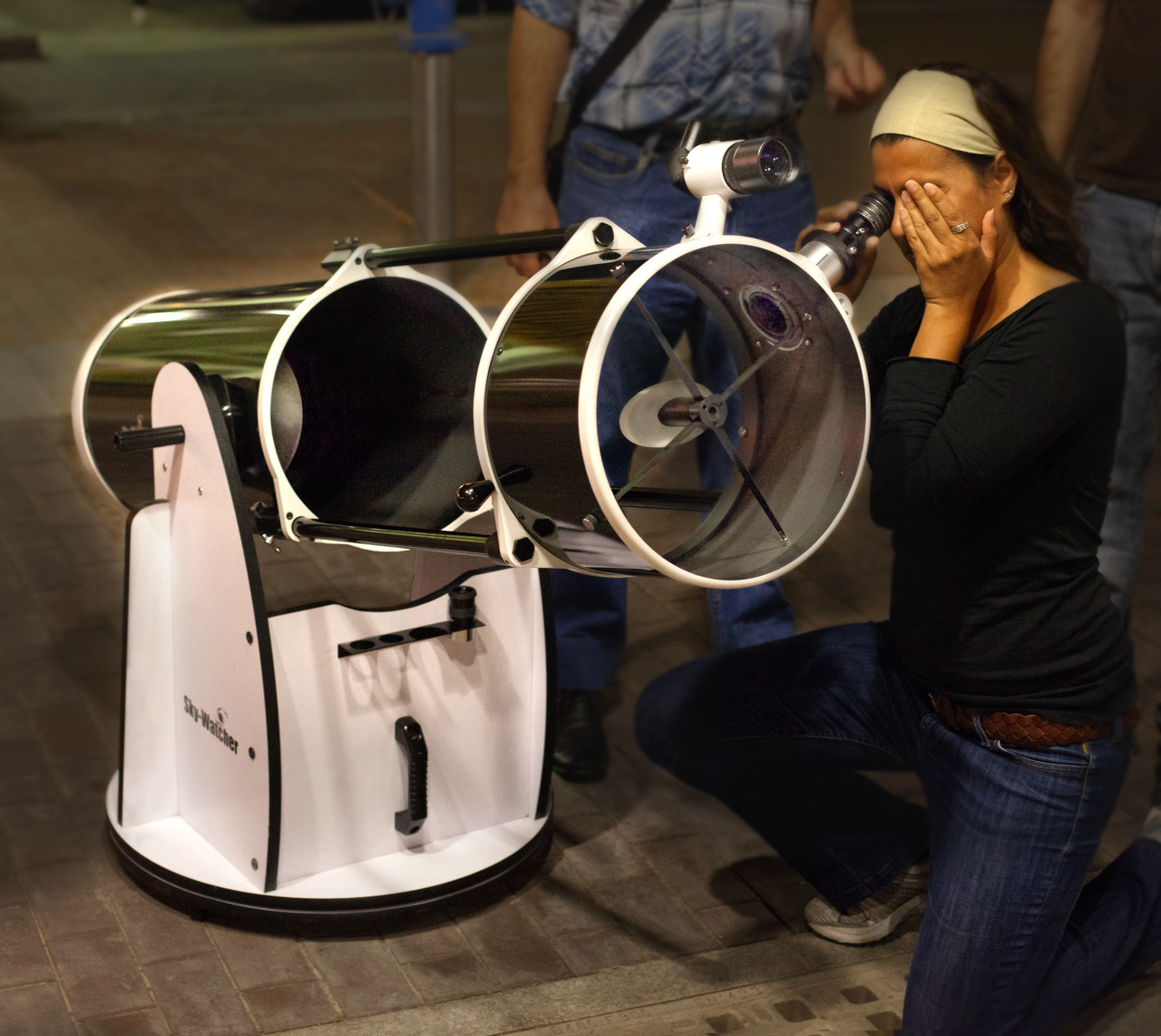
Today, the Newtonian telescope is very popular among
amateur astronomers due to its simple, inexpensive design.
 |
|
|
To be continued
—————————| Vocademy |