| Vocademy |
Astronomy for Amateurs
Chapter 9
Tycho
Copernicus brought astronomy back to the heliocentric idea first proposed by Aristarchus, and he supplied the mathematical framework needed to make reasonably accurate predictions of planetary positions. His model was a major step forward, but it was still not precise enough for astronomy to progress beyond approximate forecasts.
The problem wasn’t the mathematics. It was the data. Copernicus relied on ancient observations that contained significant errors, as much as several arcminutes,[1] and his own measurements were made with small instruments whose accuracy was limited by their size and construction. As a result, even the best heliocentric calculations were built on shaky observational foundations.
Astronomy had reached a point where theory alone could go no further. To test competing models, refine planetary motions, and uncover the true structure of the solar system, the science needed highly accurate measurements, far more precise than any ever made before. Someone had to rebuild the observational foundation of astronomy from the ground up.
Enter Tycho Brahe
Tycho Brahe (TEE‑ko BRAH‑huh[2]) was born Tyge Ottesen Brahe at Knutstorp Castle in Scania (today part of Sweden, but then a Danish province) in 1546. He was an heir to several of Denmark’s most influential noble families. From age two, he was raised by his paternal uncle, Jørgen Brahe, and aunt, Inger Oxe, the only sibling not raised by his parents. His uncle intended him for a career as a civil servant, a traditional path for someone of Tycho’s status.
From ages six through twelve, Tycho attended Latin school and then began studies at the University of Copenhagen. Although he formally studied law, he became increasingly interested in astronomy and was also trained in Aristotelian physics and cosmology.
He experienced the solar eclipse of 21 August 1560, which occurred one day later than the predicted date. The discrepancy impressed him deeply. He realized that accurate observations were essential for making better predictions.
In 1563, Tycho observed a close conjunction of Jupiter and Saturn and found that both the Ptolemaic and Copernican tables predicted the event inaccurately. This further convinced him that repeated, highly accurate measurements were needed for astronomy to progress.
While Tycho was studying in Leipzig, Denmark was at war with Sweden. His foster father became a national hero after helping to sink a Swedish warship. But shortly after Tycho’s return, Jørgen was involved in rescuing King Frederick II from drowning and contracted a fever, dying soon afterward. Tycho lost the man who had raised him and who had intended him for a career in civil service.
In 1566, Tycho left to study medical alchemy and herbal medicine at the University of Rostock in what is now Germany. That same year, at age twenty, he fought a drunken sword duel with his third cousin over who was the better mathematician. Tycho gained a deep cut across his forehead and lost part of his nose, after which he wore a metal prosthesis. The prosthesis was traditionally described as silver and gold, though modern analysis of a bone sample suggests it may have been copper or brass.
In Tycho’s time, the science of astronomy as we know it didn’t exist. Scholars who studied the heavens, no matter how careful or mathematical, were usually practicing astrological divination. When Tycho returned home from his early travels, he intended to become an astrologer, a plan his foster mother supported. His father preferred that he study law, but Tycho was allowed to continue his education abroad.
During these years he built increasingly large instruments, including a great quadrant in Augsburg. Its size and stability allowed far more accurate measurements than anything he had used before. In 1568, he accepted a largely honorary position as a canon, which gave him the financial freedom to focus entirely on measurement and study.
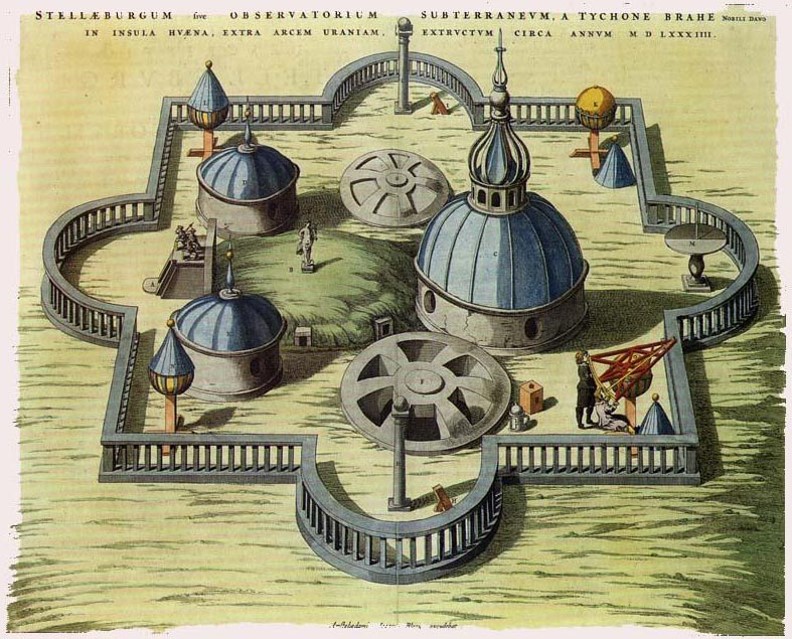
In 1576, Tycho Brahe began building Uraniborg on the island of Hven, the first purpose‑built scientific research center in Europe. It housed workshops, laboratories, living quarters, and a forest of enormous instruments—quadrants, sextants, and armillary spheres—mounted on walls and platforms in the open air. But even these massive devices were vulnerable to wind and vibration. To eliminate this last source of error, Tycho built a second observatory in 1581: Stjerneborg, an underground complex where instruments were anchored in masonry chambers and sighted through carefully controlled openings in the roof. The stability of Stjerneborg allowed Tycho to achieve unprecedented precision. This set the stage for the next event, which devastated Aristotelian astronomy.
 |
|
|
The nova of 1572
In 1572, a new star appeared in the constellation
Cassiopeia. This star outshone Venus and was easily visible in daylight, casting
shadows at night.
The nova of 1572 struck at the heart of Aristotelian
cosmology. Aristotle taught that the heavens beyond the Moon were perfect,
eternal, and unchanging. But Tycho measured the nova’s parallax[3]
and found none, proving that this “new star” was located among the fixed stars
themselves. A new object appearing in the supposedly eternal heavens was
impossible under Aristotle’s system. With a single observation, Tycho
demonstrated that the heavens could change, collapsing the Aristotelian
universe.
The Great Comet of 1577
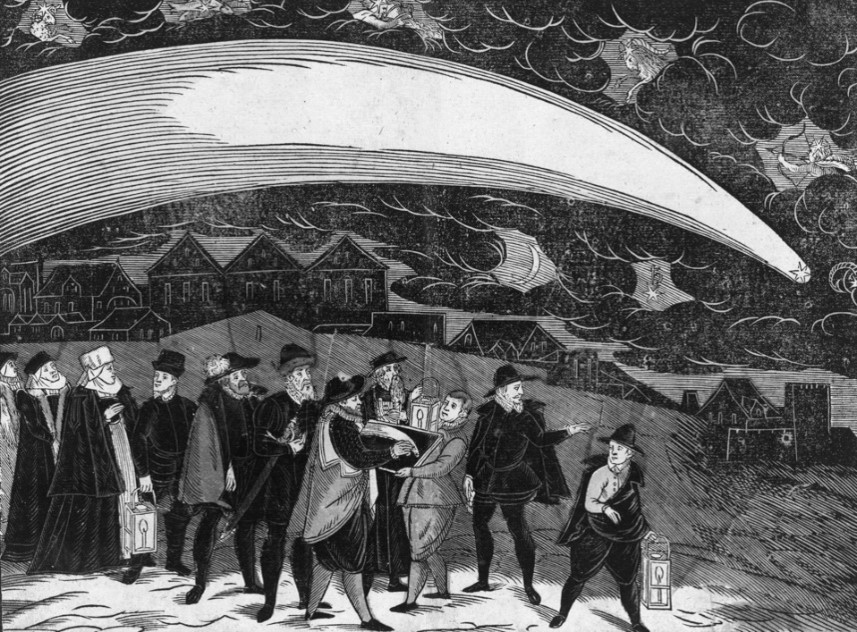
In November of 1577, another ominous apparition emerged in
the sky. A dim, nebulous patch, like a faint fuzzy star, materialized in the
constellation Sagittarius. Night after night it swelled in brightness, blooming
into a blazing torch with a tail that soon stretched across much of the heavens.
It was the Great Comet of 1577.
 |
|
|
For centuries, comets were feared as fiery omens, wandering torches that foretold plague, war, or the fall of kings. When the great comet of 1577 blazed across the sky, Europe reacted with the usual dread. But for Tycho Brahe, the comet carried a different kind of warning. Its appearance threatened not earthly kingdoms but the very architecture of the cosmos.
Prior to this time, comets were thought to be fiery exhalations rising from the Earth’s surface into the upper region of the air. They were thought to be between the Earth and the Moon, in the elemental region rather than the celestial region. If this blazing wanderer moved freely among the planets, then the solid celestial spheres Aristotle had described two thousand years earlier could not exist. The comet was not a sign of earthly disaster; it was a sign that the ancient universe was about to collapse.
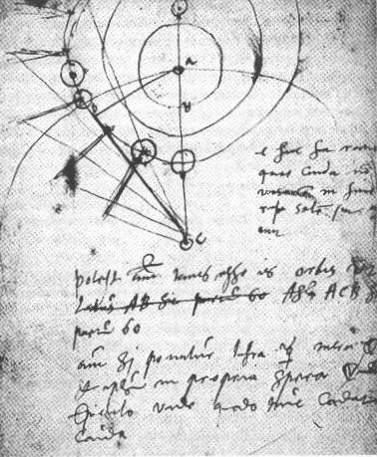
If the comet truly wandered between the Earth and the Moon, its distance could be measured as the Lunar distance had. Tycho again turned to parallax, the slight shift in an object’s position against the background stars as Earth rotates. A nearby object would show a noticeable displacement; a distant one would not. Night after night, Tycho measured the comet’s position with his great instruments at Stjerneborg. Unlike the nova of 1572, which showed no parallax at all, the comet displayed a small but definite shift over the hours of a night. This placed it beyond the Moon but closer than the fixed stars, deep within the supposedly solid celestial spheres.
The comet of 1577 delivered the final blow to the Aristotelian universe. Aristotle taught that the planets were carried by solid, crystalline spheres, each one nested inside the next. But Tycho’s measurements showed that the comet lay far beyond the Moon, moving freely through the planetary region. Its path crossed several of the supposed celestial spheres, something impossible if the spheres were solid. With this single observation, Tycho demonstrated that the celestial spheres did not exist, and the mechanical structure of the Aristotelian cosmos collapsed.
 |
|
|
Tycho’s model of the universe
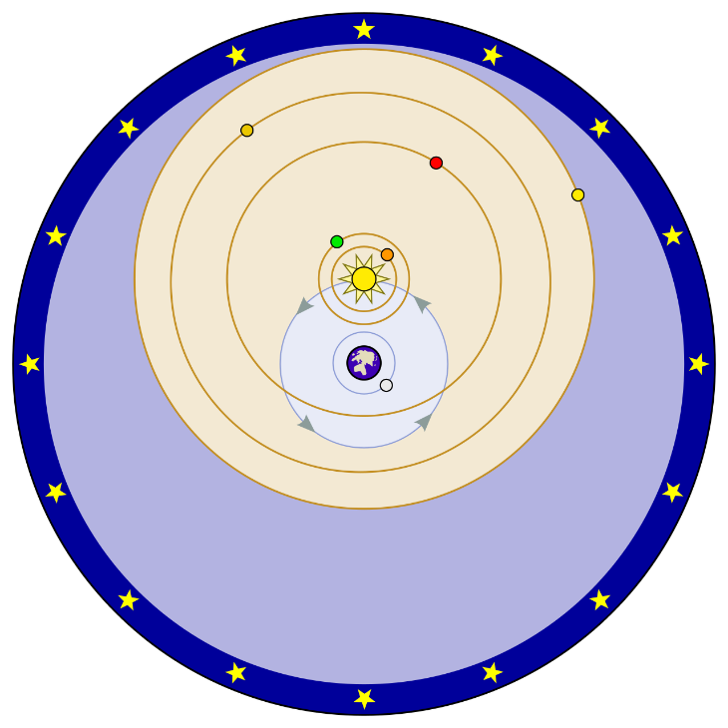
After dismantling the Aristotelian cosmos with the nova of
1572 and the comet of 1577, Tycho Brahe proposed a new model of the universe to
replace it. In Tycho’s system, Earth remained fixed at the center, unmoving as
Aristotle had taught. But the Sun no longer circled the Earth alone; instead,
the Sun carried with it all the planets, each orbiting the Sun while the Sun
orbited Earth. This geoheliocentric model preserved a stationary Earth while
adopting the mathematical advantages of Copernicus, explaining planetary
retrograde motion without requiring the Earth to move. It was a bold hybrid:
philosophically conservative, scientifically progressive, and grounded in
Tycho’s unprecedented observations.
 |
|
|
Tycho’s model, like every model before it, still relied on
perfect circular motion. And as Tycho’s instruments grew more precise, the
planets stubbornly refused to follow perfect circles. Their motions deviated,
slightly, but measurably, from the predictions of both Ptolemy and Copernicus.
Tycho knew the tables were wrong, but he did not live long enough to discover
why. That task fell to his assistant, Johannes Kepler, who inherited Tycho’s
treasure of observations after Tycho’s death in 1601.
Tycho Brahe reshaped the heavens. He destroyed the
Aristotelian spheres, proved the heavens were mutable, built the most advanced
observatories of the age, and produced the data that would lay the foundation
for modern astronomy. His own model was a brilliant bridge between the ancient
and the modern, but it was Kepler who would cross that bridge. With Tycho’s
observations, Kepler would uncover the true geometry of the planets and begin
the transformation of astronomy from a philosophical tradition into a
mathematical science.
Terms learned in this chapter
Arcminute
Nova
| Vocademy |